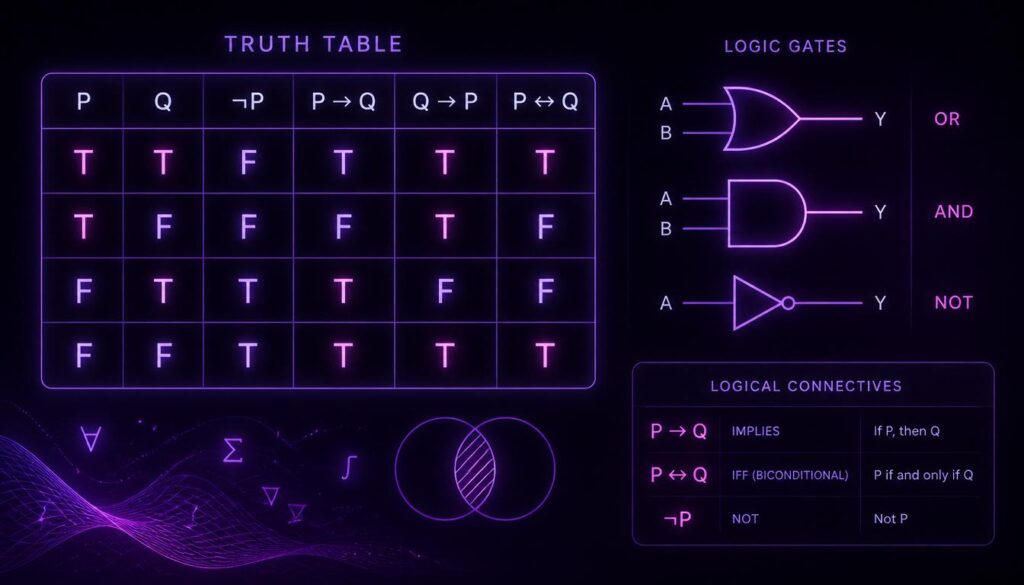
Discrete Math Truth Tables: Conditional Statements, Truth Tables & Tautology Explained with Examples
1 Truth Table for P → ¬P
We negate P, then apply the conditional. A conditional is false only when the left side is true and the right side is false.
| P | ¬P | P → ¬P |
|---|---|---|
| T | F | F |
| F | T | T |
The final column has both T and F, so P → ¬P is a contingency — its truth depends on the value of P.
2 Truth Table for (P ∨ ¬r) ∧ (q ∨ P)
With three variables (P, q, r) we need 2³ = 8 rows. We build each part — ¬r, then the two disjunctions — and finally combine them with AND.
| P | q | r | ¬r | P ∨ ¬r | q ∨ P | (P∨¬r) ∧ (q∨P) |
|---|---|---|---|---|---|---|
| T | T | T | F | T | T | T |
| T | T | F | T | T | T | T |
| T | F | T | F | T | T | T |
| T | F | F | T | T | T | T |
| F | T | T | F | F | T | F |
| F | T | F | T | T | T | T |
| F | F | T | F | F | F | F |
| F | F | F | T | T | F | F |
3 Proving a Tautology: (P → Q) ↔ (¬Q → ¬P)
This is the contrapositive law. A conditional and its contrapositive are always logically equivalent, so the biconditional joining them should be true in every row.
| P | Q | P → Q | ¬Q | ¬P | ¬Q → ¬P | ↔ |
|---|---|---|---|---|---|---|
| T | T | T | F | F | T | T |
| T | F | F | T | F | F | T |
| F | T | T | F | T | T | T |
| F | F | T | T | T | T | T |
Every row in the final column is T, which confirms the equivalence.
Result: Tautology4 Testing (P → Q) → (Q → P)
It is tempting to assume this is a tautology, but a conditional and its converse are not equivalent. Watch the row where P is false and Q is true.
| P | Q | P → Q | Q → P | (P→Q) → (Q→P) |
|---|---|---|---|---|
| T | T | T | T | T |
| T | F | F | T | T |
| F | T | T | F | F |
| F | F | T | T | T |
When P = F and Q = T: P → Q is T, but Q → P is F, so T → F gives F. Because one row is false, this is not a tautology.
Result: Contingency5 Converse, Inverse & Contrapositive
Take the statement: “I came to class whenever there is going to be a quiz.” First we define our propositions, then write all four standard forms.
Q = I came to class.
The original statement “whenever P, then Q” translates to P → Q.
Remember: the contrapositive always has the same truth value as the original, while the converse and inverse may not.